
Answer
to Case 60
The arthropod was a nymphal hard tick (order Acarina, family Ixodidae), which
are morphologically different from soft ticks such as Ornithodoros
spp. from the family Argasidae). This particular nymphal tick
was probably a Lone star tick (Amblyoma americanum), though species
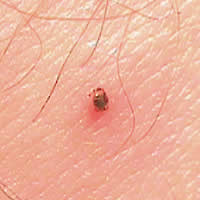
identification of nymphal ticks is usually not absolute. Figure
A shows a tick still attached to the same person featured in this
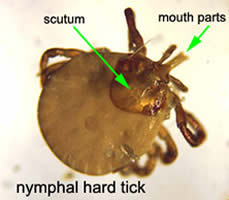
month's case studies. Diagnostic features of hard ticks include
the following, which are also labeled in Figure B:
- The mouth parts are visible from the dorsal view. Mouth parts of soft ticks are subterminally attached and thus not visible from a dorsal view.
- The presence of a dorsal plate (scutum). This feature is absent in soft ticks.
- Hard ticks display sexual dimorphism, meaning that there are visual differences between males and females (e.g., the scutum is larger in males than in females).
 |
 |
| A | B |
Ticks are important arthropod vectors of human disease, second only to mosquitoes. Some of the diseases that can be transmitted by hard ticks are listed below:
- Babesiosis—vector is Ixodes scapularis (black legged tick).
- Lyme Disease—vectors are Ixodes scapularis and I. pacificus.
- Erlichiosis—vector is Amblyoma americanum (Lone star tick).
- Rocky Mountain Spotted Fever—vectors are Dermacentor variablis (American dog tick) and D. andersoni (Rocky Mountain wood tick).
Soft ticks are vectors of relapsing fever, a spirochetal disease. In addition, it is important to be able to distinguish ticks from other arthropods, such as lice or fleas.
|