
 |
[Last Modified: ] |
Case
37
A 12-year-old boy was seen in a Delaware physician’s office for a pruritic
rash on his hands and wrists. His mother reported that two weeks
prior, she and her son visited some local marshlands to observe the large
flocks of geese that had been sighted in the area. While there,
her son noticed some snails along the beaches and wanted to keep them
as pets. He collected a dozen snails along with a bucket of sand
and water from where he found the snails. After returning home,
he set the snails up in a five-gallon aquarium with about two inches of
sand and two inches of beach water. She told the physician that
her son would occasionally handle the snails in the water bare-handed.
The physician asked her to bring some of the snails and water to
him so that he could forward the snails to a colleague at CDC for investigation.
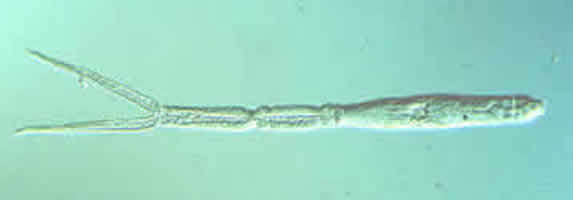
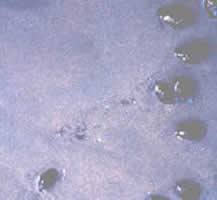
The following images show what was found in the aquarium water (Figure
A) and what the snails looked like (Figure B). The
snails averaged about 30mm in length and the object in the Figure A
is about 320 micrometers in length (magnification 100×). What is
your diagnosis? Based on what criteria?
 |
| A |
 |
| B |
Click here for the answer to Case 37.
Case
38
A 45-year-old man was admitted to an Ohio emergency room for headache, fever,
general muscle aches, and weakness. Laboratory work-up on his blood
specimen revealed significantly elevated eosinophilia. The patient
reported that he had gone on a camping and hunting trip the month before
in Ontario, Canada. He shot and killed a black bear and brought
several pounds of meat home. In the weeks before onset of symptoms,
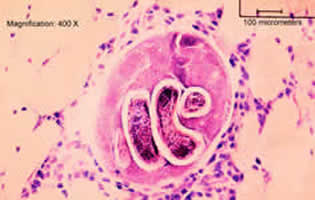
he ate several meals that included bear meat. Figure A shows
what was seen in a stained section of muscle biopsy taken from the deltoid
area of his left arm. Portions of the remaining bear meat were sent
to CDC for examination. No parasites were found in compression smears
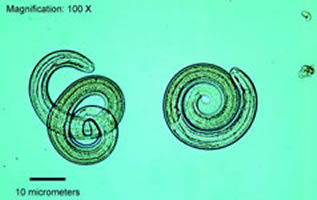
from the bear meat (muscle). A 100 g portion of meat was ground
and digested in an acidic pepsin solution. Examination of the sediment
revealed small numbers of the objects shown in Figure B. What
is your diagnosis? Based on what criteria?
 |
 |
| A | B |
Click here for the answer to Case 38.
|
|||
|
|||
|
|||
|
|||
|

