
 |
[Last Modified: ] |
Case
63
A family from Afghanistan immigrated to the United States to live in Missouri.
Stool specimens were collected from all family members and submitted to
the Missouri State Health Laboratory for an O & P (ova and parasites) examination.
The specimens were divided into vials containing 10% formalin and PVA. Smears were made from the PVA preserved specimens, stained
with trichrome stain, and examined. The 10% formalin-preserved specimens
were concentrated using the FEA (formalin-ethyl acetate) concentration
method. Wet mounts of the sediment were examined. Some of the
organisms identified in the stool specimens from family members included
Giardia intestinalis (lamblia) cysts, Endolimax nana
cysts and trophozoites, Hymenolepis nana eggs, and Entamoeba
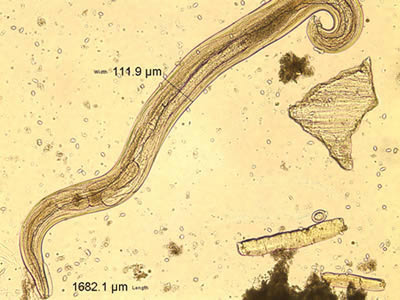
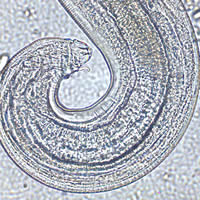
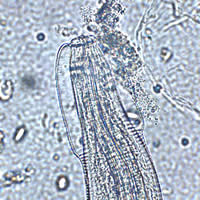
hartmanni cysts and trophozoites. A worm-like object was discovered
in the stool concentrate from a 5-year-old family member. Figures
A, B, and C are detailed images of the object.
What is your diagnosis? Based on what criteria?
 |
| A |
 |
 |
| B | C |
Acknowledgement: The images and clinical history for this case were kindly provided by the Missouri State Health Laboratory.
Click here for the answer to Case 63.
Case
64
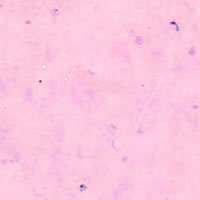
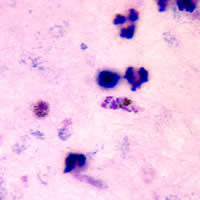
A 26-year-old man from India moved to the United States in January 2001. He went
to a hospital emergency room for fever and chills.
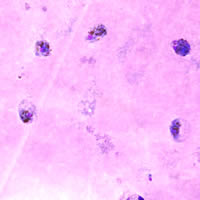
Blood films were prepared and sent to the laboratory to be stained with Giemsa and examined. Figures A, B, and C show
what was observed on one of the stained thick films. What is your
diagnosis? Based on what criteria?
 |
 |
| A | B |
 |
| C |
Acknowledgement: This case was kindly provided by the Ohio Department of Health.
Click here for the answer to Case 64.
Images presented in the monthly case studies are from specimens submitted for diagnosis or archiving. On rare occasions, clinical histories given may be partly fictitious.
|
|||
|
|||
|
|||
|
|||
|

