
 |
[Last Modified: ] |
 |
|
| [Angiostrongylus cantonensis] [Angiostrongylus costaricensis] |
 |
 |
 |
 |
 |
 |
|
Causal Agents:
The nematode
(roundworm) Angiostrongylus cantonensis, the rat lungworm, is the most common cause
of human eosinophilic meningitis. In addition, Angiostrongylus (Parastrongylus)
costaricensis is the causal agent of abdominal, or intestinal, angiostrongyliasis.
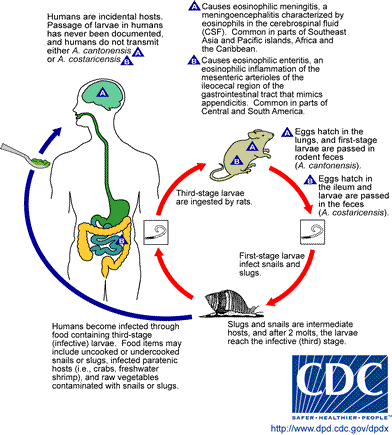
Adult worms of A. cantonensis live in the pulmonary arteries of rats. The females lay eggs that hatch, yielding first-stage larvae, in the terminal branches of the pulmonary arteries. The first-stage larvae migrate to the pharynx, are swallowed, and passed in the feces. They penetrate, or are ingested by, an intermediate host (snail or slug). After two molts, third-stage larvae are produced, which are infective to mammalian hosts. When the mollusk is ingested by the definitive host, the third-stage larvae migrate to the brain where they develop into young adults. The young adults return to the venous system and then the pulmonary arteries where they become sexually mature. Of note, various animals act as paratenic (transport) hosts: after ingesting the infected snails, they carry the third-stage larvae which can resume their development when the paratenic host is ingested by a definitive host. Humans can acquire the infection by eating raw or undercooked snails or slugs infected with the parasite; they may also acquire the infection by eating raw produce that contains a small snail or slug, or part of one. There is some question whether or not larvae can exit the infected mollusks in slime (which may be infective to humans if ingested, for example, on produce). The disease can also be acquired by ingestion of contaminated or infected paratenic animals (crabs, freshwater shrimps). In humans, juvenile worms migrate to the brain, or rarely in the lungs, where the worms ultimately die. The life cycle of Angiostrongylus (Parastrongylus) costaricensis is similar, except that the adult worms reside in the arterioles of the ileocecal area of the definitive host. In humans, A. costaricensis often reaches sexual maturity and release eggs into the intestinal tissues. The eggs and larvae degenerate and cause intense local inflammatory reactions and do not appear to be shed in the stool.
Geographic
Distribution:
Most cases of
eosinophilic meningitis have been reported from Southeast Asia and the Pacific
Basin, although the infection is spreading to many other areas of the world,
including Africa and the Caribbean. Abdominal angiostrongyliasis has been reported from Costa Rica, and occurs
most commonly in young children.
|
||||||||
|
||||||||
|
||||||||
|
||||||||
|


