
 |
[Last Modified: ] |
 |
|
| [Blastocystis hominis] |
 |
 |
 |
 |
 |
 |
|
Causal Agent:
The taxonomic
classification of Blastocystis hominis is mired in controversy.
It has been previously considered as yeasts, fungi, or ameboid, flagellated,
or sporozoan protozoa. Recently, however, based on molecular studies,
especially dealing with the sequence information on the complete SSUrRNA
gene, B. hominis has been placed within an informal group, the
stramenoiles (Silberman et al. 1996). Stramenopiles are defined, based
on molecular phylogenies, as a heterogeneous evolutionary assemblage of
unicellular and multicellular protists including brown algae, diatoms,
chrysophytes, water molds, slime nets, etc. (Patterson, 1994).
Cavalier-Smith (1998) considers stramenopiles to be identical to his
infrakingdom Heterokonta under the kingdom Chromista. Therefore,
according to Cavalier-Smith, B. hominis is a heterokontid chromista.
References:
- Silberman JD, Sogin ML, Leipe DD, Clark CG. Human parasite finds taxonomic home. Nature 1996;380:398.
- Patterson DJ. Protozoa, evolution and systematics. In: Housmann K, Hulsmann N, editors. Progress in Protozoology. Stuttgart: Fischer; 1994. p. 1-14.
- Cavalier-Smith T. A revised six-kingdom system of life. Biol Rev Camb Philos Soc 1998;73:203-266.
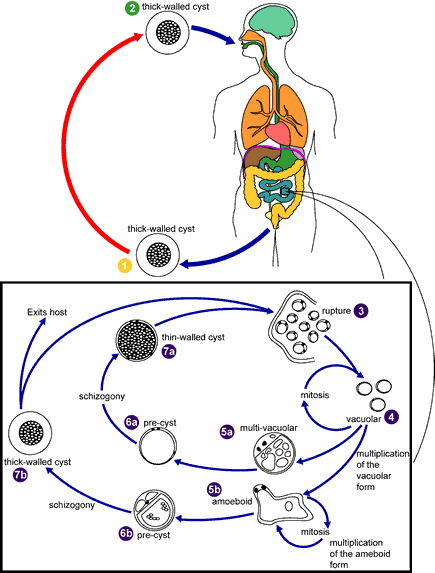
Blastocystis hominis stages were reproduced from Singh M, Suresh K, Ho LC, Ng GC, Yap EH. Elucidation of the life cycle of the intestinal protozoan Blastocystis hominis. Parasitol Res 1995;81:449. Copyright held by Springer-Verlag and reproduced here by permission of Springer-Verlag and M. Singh.
Knowledge of the life cycle and transmission is still under
investigation, therefore this is a proposed life cycle for B. hominis. The
classic form found in human stools is the cyst, which varies tremendously in
size from 6 to 40 μm
 . The thick-walled cyst present in the stools
is believed to be responsible for external transmission, possibly by the fecal-oral route through ingestion of contaminated water or food
. The thick-walled cyst present in the stools
is believed to be responsible for external transmission, possibly by the fecal-oral route through ingestion of contaminated water or food
 . The cysts
infect epithelial cells of the digestive tract and multiply asexually
(
. The cysts
infect epithelial cells of the digestive tract and multiply asexually
( ,
,
 ). Vacuolar forms of the parasite give origin to multi-vacuolar
 and ameboid
 forms. The multi-vacuolar develops into a pre-cyst
 that
gives origin to a thin-walled cyst
that
gives origin to a thin-walled cyst
 , thought to be responsible for
autoinfection. The ameboid form gives origin to a pre-cyst
, thought to be responsible for
autoinfection. The ameboid form gives origin to a pre-cyst
 , which
develops into thick-walled cyst by schizogony
, which
develops into thick-walled cyst by schizogony
 . The thick-walled cyst is
excreted in feces
.
. The thick-walled cyst is
excreted in feces
.
|
||||||||
|
||||||||
|
||||||||
|
||||||||
|


