
 |
[Last Modified: ] |
 |
|
 |
 |
 |
 |
 |
 |
|
Causal
Agent:
Cercarial
dermatitis is caused by the cercariae of certain species of schistosomes
whose normal hosts are birds and mammals other than humans. These cercariae
seem to have a chemotrophic reaction to secretions from the skin and are
not as host-specific as other types of schistosomes. They attempt to,
and, sometimes may actually, enter human skin. The penetration causes
a dermatitis which is usually accompanied with intense itching, but the
cercariae
do not mature into adults in the human body. Cases of cercarial dermatitis
can occur in both fresh and brackish water environments. One species of
schistosome often implicated in cases of cercarial dermatitis is Austrobilharzia
variglandis, whose normal hosts are ducks. The snail, Nassarius
obsoletus,
is the intermediate host for this species and can be found at marine beaches
in temperate climates. Cercarial dermatitis should not be confused with
seabather's eruption, which is caused by the larval stage of cnidarians
(e.g., jellyfish). The areas of skin affected by seabather's
eruption is generally
under the garments worn by bathers and swimmers where the organisms are
trapped after the person leaves the water. Cercarial dermatitis occurs
on the exposed skin outside of close-fitting garments.
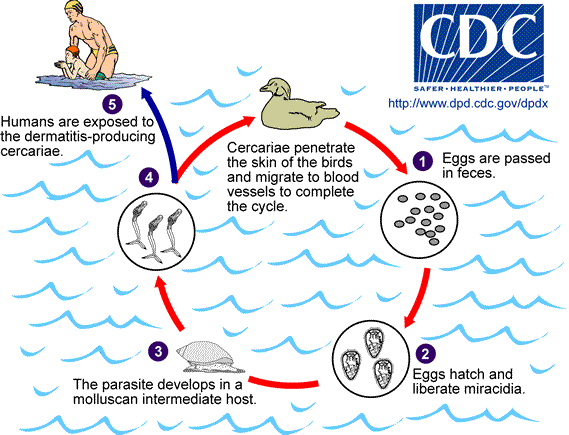
Typically,
hosts of avian schistosomes are migratory water birds, including shorebirds,
ducks, and geese. Adult worms are found in the blood vessels and produce
eggs that are swallowed and passed in the feces
 . On exposure to water,
the eggs hatch and liberate a ciliated miracidium that infects a suitable
molluscan intermediate host
. On exposure to water,
the eggs hatch and liberate a ciliated miracidium that infects a suitable
molluscan intermediate host
 . The parasite develops
in the intermediate
host, usually a certain species of snail
. The parasite develops
in the intermediate
host, usually a certain species of snail
 , to produce free-swimming cercariae
that are released under appropriate conditions and penetrate the skin
of the birds to complete the cycle
, to produce free-swimming cercariae
that are released under appropriate conditions and penetrate the skin
of the birds to complete the cycle
 . Humans are inadvertent and inappropriate
hosts; cercariae may penetrate the skin but do not develop further
. Humans are inadvertent and inappropriate
hosts; cercariae may penetrate the skin but do not develop further
 .
A number of species of dermatitis-producing cercariae have been described
from both freshwater and saltwater environments, and exposure to either
type of cercariae will sensitize persons to both.
.
A number of species of dermatitis-producing cercariae have been described
from both freshwater and saltwater environments, and exposure to either
type of cercariae will sensitize persons to both.
Geographic
Distribution:
Cercarial dermatitis occurs worldwide with cases reported from every continent except
Antarctica. In the United States, cases are commonly reported from the Great Lakes
region.
|
||||||||
|
||||||||
|
||||||||
|
||||||||
|


