|
Causal Agent:
Despite its name,
Dientamoeba fragilis is not an ameba but a flagellate. This
protozoan parasite produces trophozoites; cysts have not been identified.
Infection may be either symptomatic or asymptomatic.
Life Cycle:
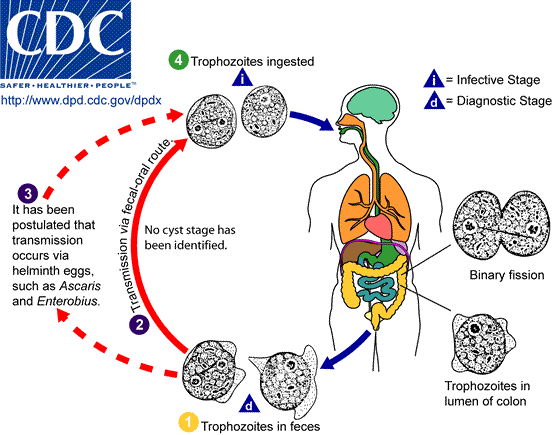
The complete life
cycle of this parasite has not yet been determined, but assumptions were made based on clinical data. To date,
the cyst stage has not
been identified in D. fragilis life cycle, and the trophozoite is the only stage found in stools of infected individuals
 .
D. fragilis is probably transmitted by fecal-oral route .
D. fragilis is probably transmitted by fecal-oral route
 and transmission via helminth eggs (e.g., Ascaris, Enterobius
spp.) has been postulated and transmission via helminth eggs (e.g., Ascaris, Enterobius
spp.) has been postulated
 .
Trophozoites of D. fragilis have characteristically one or two
nuclei (, .
Trophozoites of D. fragilis have characteristically one or two
nuclei (,
 ), and it is found in children complaining of intestinal (e.g.,
intermittent diarrhea, abdominal pain) and other symptoms (e.g., nausea,
anorexia, fatigue, malaise, poor weight gain). ), and it is found in children complaining of intestinal (e.g.,
intermittent diarrhea, abdominal pain) and other symptoms (e.g., nausea,
anorexia, fatigue, malaise, poor weight gain).
Geographic
Distribution:
Worldwide.
|
|





