
 |
[Last Modified: ] |
 |
|
| [Dipylidium caninum] |
 |
 |
 |
 |
 |
 |
|
Causal Agent:
Dipylidium caninum (the
double-pored dog tapeworm) mainly infects dogs and cats, but is occasionally found in
humans.
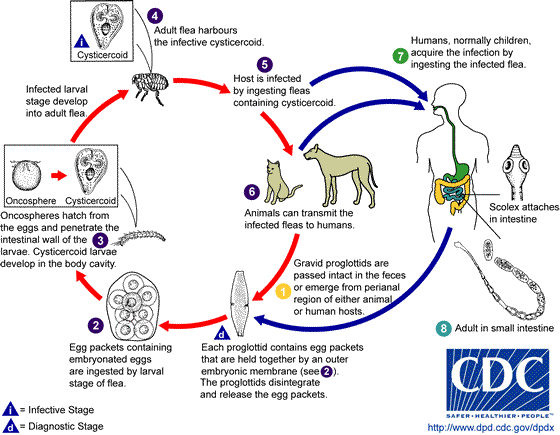
Gravid proglottids are passed intact in the feces or emerge from the perianal region of the host
 .
Subsequently they release typical egg packets
.
Subsequently they release typical egg packets
 .
On rare occasions, proglottids rupture and egg packets are seen in stool samples.
Following ingestion of an
egg by the intermediate host (larval stages of the dog or cat flea Ctenocephalides spp.), an oncosphere is released into the flea's intestine.
The oncosphere
penetrates the intestinal wall, invades the insect's hemocoel (body cavity), and develops into a cysticercoid larva
.
On rare occasions, proglottids rupture and egg packets are seen in stool samples.
Following ingestion of an
egg by the intermediate host (larval stages of the dog or cat flea Ctenocephalides spp.), an oncosphere is released into the flea's intestine.
The oncosphere
penetrates the intestinal wall, invades the insect's hemocoel (body cavity), and develops into a cysticercoid larva
 .
The larva develops into an adult, and
the adult flea harbours the infective cysticercoid
.
The larva develops into an adult, and
the adult flea harbours the infective cysticercoid
 .
The vertebrate host becomes infected by ingesting the adult flea containing the cysticercoid
.
The vertebrate host becomes infected by ingesting the adult flea containing the cysticercoid
 .
The dog
is the principal definitive host for Dipylidium caninum.
Other potential hosts include cats, foxes, and humans (mostly children)
.
The dog
is the principal definitive host for Dipylidium caninum.
Other potential hosts include cats, foxes, and humans (mostly children)
 ,
,
 .
Humans acquire
infection by ingesting the cysticercoid contaminated flea. This can be promulgated by close contact between children and their infected pets.
In the small
intestine of the vertebrate host the cysticercoid develops into the adult tapeworm which reaches maturity about 1 month after infection
.
Humans acquire
infection by ingesting the cysticercoid contaminated flea. This can be promulgated by close contact between children and their infected pets.
In the small
intestine of the vertebrate host the cysticercoid develops into the adult tapeworm which reaches maturity about 1 month after infection
 .
The adult
tapeworms (measuring up to 60 cm in length and 3 mm in width) reside in the small intestine of the host, where they each attach by their scolex.
They
produce proglottids (or segments) which have two genital pores (hence the name "double-pored" tapeworm).
The proglottids mature, become gravid, detach
from the tapeworm, and migrate to the anus or are passed in the stool
.
.
The adult
tapeworms (measuring up to 60 cm in length and 3 mm in width) reside in the small intestine of the host, where they each attach by their scolex.
They
produce proglottids (or segments) which have two genital pores (hence the name "double-pored" tapeworm).
The proglottids mature, become gravid, detach
from the tapeworm, and migrate to the anus or are passed in the stool
.
Geographic
Distribution:
Worldwide. Human
infections have been reported in Europe, the Philippines, China, Japan, Argentina and the
United States.
|
||||||||
|
||||||||
|
||||||||
|
||||||||
|


