
 |
[Last Modified: ] |
 |
|
| [Fasciola hepatica] [Fasciola gigantica] |
 |
 |
 |
 |
 |
 |
|
Causal Agents:
The trematodes Fasciola
hepatica (the sheep liver fluke) and Fasciola gigantica, parasites of
herbivores that can infect humans accidentally.
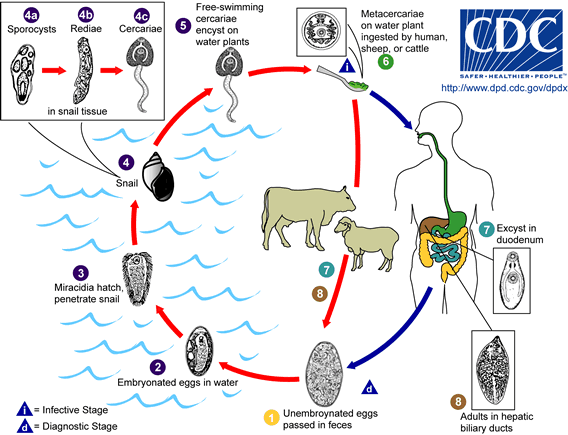
Immature eggs are discharged in the biliary
ducts and in the stool
 .
Eggs become embryonated in water
.
Eggs become embryonated in water
 ,
eggs release miracidia
,
eggs release miracidia
 ,
which invade a suitable snail intermediate host
,
which invade a suitable snail intermediate host
 ,
including many species of the genus Lymnae. In the snail the parasites undergo
several developmental stages (sporocysts
,
including many species of the genus Lymnae. In the snail the parasites undergo
several developmental stages (sporocysts
 ,
rediae
,
rediae
 , and
cercariae
, and
cercariae
 ). The cercariae are
released from the snail
). The cercariae are
released from the snail
 and encyst as metacercariae on aquatic vegetation or other
surfaces. Mammals acquire the infection by eating vegetation containing
metacercariae. Humans can become infected by ingesting metacercariae-containing freshwater plants, especially
watercress
and encyst as metacercariae on aquatic vegetation or other
surfaces. Mammals acquire the infection by eating vegetation containing
metacercariae. Humans can become infected by ingesting metacercariae-containing freshwater plants, especially
watercress
 .
After ingestion, the metacercariae excyst in the duodenum
.
After ingestion, the metacercariae excyst in the duodenum
 and migrate
through the intestinal wall, the peritoneal cavity, and the liver parenchyma into the
biliary ducts, where they develop into adults
and migrate
through the intestinal wall, the peritoneal cavity, and the liver parenchyma into the
biliary ducts, where they develop into adults
 . In humans,
maturation from metacercariae into adult flukes takes approximately 3 to 4
months. The adult flukes (Fasciola
hepatica: up to 30 mm by 13 mm; F. gigantica: up to 75 mm) reside in the
large biliary ducts of the mammalian host. Fasciola hepatica infect
various animal species, mostly herbivores.
. In humans,
maturation from metacercariae into adult flukes takes approximately 3 to 4
months. The adult flukes (Fasciola
hepatica: up to 30 mm by 13 mm; F. gigantica: up to 75 mm) reside in the
large biliary ducts of the mammalian host. Fasciola hepatica infect
various animal species, mostly herbivores.
Geographic
Distribution:
Fascioliasis occurs
worldwide. Human infections with F. hepatica are found in areas where
sheep and cattle are raised, and where humans consume raw watercress, including Europe,
the Middle East, and Asia. Infections with F. gigantica have been reported,
more rarely, in Asia, Africa, and Hawaii.
|
||||||||
|
||||||||
|
||||||||
|
||||||||
|


