
 |
[Last Modified: ] |
 |
|
| [Brugia
malayi] [Brugia timori] [Loa loa] [Mansonella ozzardi] [Mansonella perstans] [Mansonella streptocerca] [Onchocerca volvulus] [Wuchereria bancrofti] |
 |
 |
 |
 |
 |
 |
|
Life Cycle of Mansonella ozzardi:
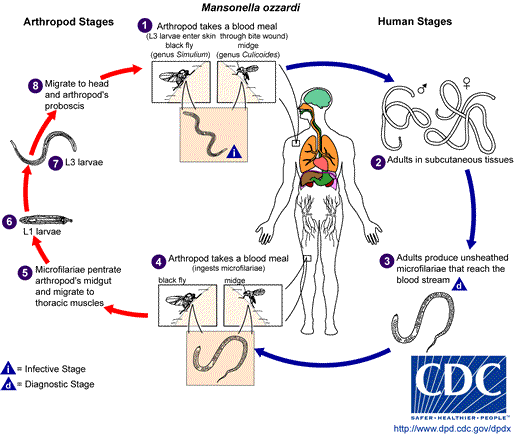
During a blood
meal, an infected arthropod (midges, genus Culicoides,
or blackflies, genus Simulium) introduces third-stage filarial larvae
onto the skin of the human host, where they penetrate into the bite wound
 .
They develop into adults that commonly reside in subcutaneous tissues
.
They develop into adults that commonly reside in subcutaneous tissues
 .
Adult worms are rarely found in humans. The size range for females
worms is 65 to 81 mm in length and 0.21 to 0.25 mm in diameter but unknown for
males. Adults worms recovered from experimentally infected Patas
monkeys measured 24 to 28 mm in length and 70 to 80 μm in diameter (males) and
32 to 62 mm in length and .130 to .160 mm in diameter (females).
Adults produce unsheathed and non-periodic microfilariae that reach the blood stream
.
Adult worms are rarely found in humans. The size range for females
worms is 65 to 81 mm in length and 0.21 to 0.25 mm in diameter but unknown for
males. Adults worms recovered from experimentally infected Patas
monkeys measured 24 to 28 mm in length and 70 to 80 μm in diameter (males) and
32 to 62 mm in length and .130 to .160 mm in diameter (females).
Adults produce unsheathed and non-periodic microfilariae that reach the blood stream
 .
The arthropod ingests microfilariae during a blood meal
.
The arthropod ingests microfilariae during a blood meal
 .
After ingestion, the microfilariae migrate from the arthropod's midgut
through the hemocoel to the thoracic muscles
.
After ingestion, the microfilariae migrate from the arthropod's midgut
through the hemocoel to the thoracic muscles
 .
There the microfilariae develop into first-stage larvae
.
There the microfilariae develop into first-stage larvae
 and subsequently into third-stage infective larvae
 .
The third-stage infective larvae migrate to arthropod's proboscis
.
The third-stage infective larvae migrate to arthropod's proboscis
 and can infect another human when the arthropod
takes a blood meal
.
and can infect another human when the arthropod
takes a blood meal
.
|
|||
|
|||
|
|||
|
|||
|

