
 |
[Last Modified: ] |
 |
|
| [Naegleria fowleri] [Acanthamoeba spp.] [Balamuthia mandrillaris] |
 |
 |
 |
 |
 |
 |
|
Causal Agents:
Naegleria fowleri
and Acanthamoeba spp., commonly found in lakes, swimming pools, tap water, and
heating and air conditioning units. While only one species of Naegleria is
known to infect humans, several species of Acanthamoeba are implicated, including
A. culbertsoni, A. polyphaga, A. castellanii, A. astronyxis, A.
hatchetti, and A. rhysodes. An additional agent of human disease, Balamuthia mandrillaris,
is a related leptomyxid ameba that is morphologically similar in light microscopy to
Acanthamoeba.
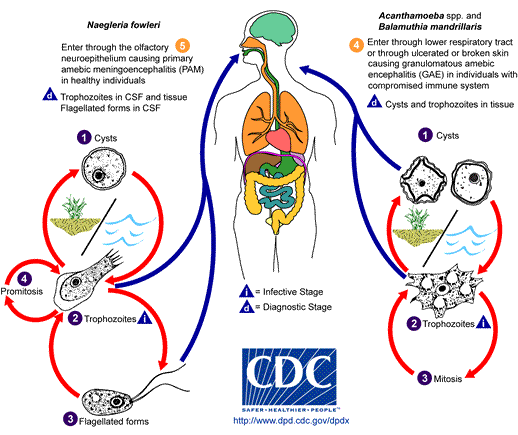
Free-living
amebae belonging to the genera Acanthamoeba, Balamuthia, and
Naegleria are important causes of disease in humans and animals. Naegleria fowleri
produces an acute, and usually lethal, central nervous system (CNS) disease
called primary amebic meingoencephalitis (PAM). N. fowleri has
three stages,
cysts
 ,
trophozoites
,
trophozoites
 ,
and flagellated forms
,
and flagellated forms
 ,
in its life cycle. The trophozoites replicate by promitosis (nuclear
membrane remains intact)
,
in its life cycle. The trophozoites replicate by promitosis (nuclear
membrane remains intact)
 . Naegleria fowleri is found in fresh water, soil, thermal discharges of power plants, heated
swimming pools, hydrotherapy and medicinal pools, aquariums, and sewage. Trophozoites can turn into
temporary flagellated forms which usually revert back to the trophozoite stage.
Trophozoites infect humans or animals by entering the olfactory neuroepithelium
. Naegleria fowleri is found in fresh water, soil, thermal discharges of power plants, heated
swimming pools, hydrotherapy and medicinal pools, aquariums, and sewage. Trophozoites can turn into
temporary flagellated forms which usually revert back to the trophozoite stage.
Trophozoites infect humans or animals by entering the olfactory neuroepithelium
 and reaching the brain. N. fowleri trophozoites are found in
cerebrospinal fluid (CSF) and tissue, while flagellated forms are found in
CSF.
and reaching the brain. N. fowleri trophozoites are found in
cerebrospinal fluid (CSF) and tissue, while flagellated forms are found in
CSF.
Acanthamoeba spp.
and Balamuthia mandrillaris are opportunistic free-living amebae
capable of causing granulomatous amebic encephalitis (GAE) in individuals
with compromised immune systems. Acanthamoeba spp. have been
found in soil; fresh, brackish, and sea water; sewage; swimming pools; contact lens equipment;
medicinal pools; dental treatment units; dialysis
machines; heating, ventilating, and air conditioning systems; mammalian cell
cultures; vegetables; human nostrils and throats; and human and animal
brain, skin, and lung tissues. B. mandrillaris however, has not been
isolated from the environment but has been isolated from autopsy specimens of infected humans and animals.
Unlike N. fowleri, Acanthamoeba, and Balamuthia have
only two stages, cysts
and trophozoites
,
in their life cycle. No flagellated stage exists as part of the life
cycle. The trophozoites replicate by mitosis (nuclear membrane does
not remain intact)
.
The trophozoites are the infective forms and are believed to gain entry into
the body through the lower respiratory tract, ulcerated or broken skin and
invade the central nervous system by hematogenous dissemination
 .
Acanthamoeba spp. and Balamuthia mandrillaris cysts and trophozoites are found in tissue.
.
Acanthamoeba spp. and Balamuthia mandrillaris cysts and trophozoites are found in tissue.
Geographic
Distribution:
While infrequent,
infections appear to occur worldwide.
|
||||||||
|
||||||||
|
||||||||
|
||||||||
|


