
 |
[Last Modified: ] |
 |
|
| [Giardia intestinalis (syn. Giardia lamblia)] |
 |
 |
 |
 |
 |
 |
|
Causal Agent:
Giardia
intestinalis, a protozoan flagellate (Diplomonadida). This protozoan was initially named
Cercomonas intestinalis by Lambl in 1859 and renamed Giardia lamblia by Stiles in 1915, in honor of
Professor A. Giard of Paris and Dr. F. Lambl of Prague. However, many
consider the name
Giardia intestinalis to be the correct name for this protozoan.
The International Commission on Zoological Nomenclature is reviewing this issue.
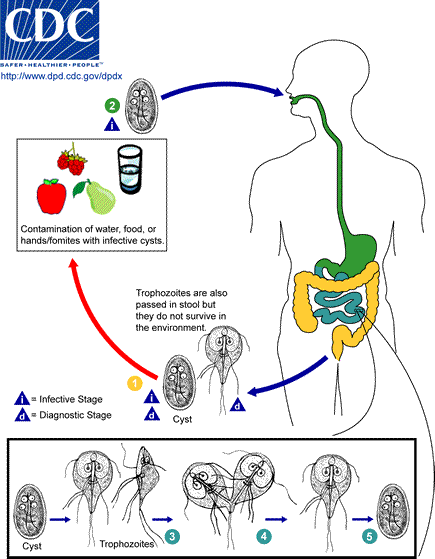
Cysts are resistant forms and are responsible for transmission of giardiasis.
Both cysts and trophozoites can be found in the feces (diagnostic stages)
 .
The cysts are hardy and can survive several months in cold water. Infection occurs by the ingestion of cysts in contaminated water, food, or by the fecal-oral route (hands or fomites)
.
The cysts are hardy and can survive several months in cold water. Infection occurs by the ingestion of cysts in contaminated water, food, or by the fecal-oral route (hands or fomites)
 . In the small intestine, excystation releases trophozoites (each cyst produces two
trophozoites)
. In the small intestine, excystation releases trophozoites (each cyst produces two
trophozoites)
 .
Trophozoites multiply by longitudinal binary fission, remaining in the lumen of the proximal small bowel where they can be free or attached to the mucosa by a ventral sucking disk
.
Trophozoites multiply by longitudinal binary fission, remaining in the lumen of the proximal small bowel where they can be free or attached to the mucosa by a ventral sucking disk
 .
Encystation occurs as the parasites transit toward the colon. The cyst
is the stage found most commonly in nondiarrheal feces
.
Encystation occurs as the parasites transit toward the colon. The cyst
is the stage found most commonly in nondiarrheal feces
 .
Because the cysts are infectious when passed in the stool or shortly afterward, person-to-person transmission is possible. While animals are infected with
Giardia, their importance as a reservoir is unclear.
.
Because the cysts are infectious when passed in the stool or shortly afterward, person-to-person transmission is possible. While animals are infected with
Giardia, their importance as a reservoir is unclear.
Geographic
Distribution:
Worldwide, more
prevalent in warm climates, and in children.
|
||||||||
|
||||||||
|
||||||||
|
||||||||
|


