
 |
[Last Modified: ] |
 |
|
| [Pediculus humanus capitis] |
 |
 |
 |
 |
 |
 |
|
Causal Agent:
Pediculus humanus capitis,
the head louse, is an insect of the order Anoplura and is an ectoparasite whose only host
are humans. The louse feeds on blood several times daily and resides
close to the scalp to maintain its body temperature.
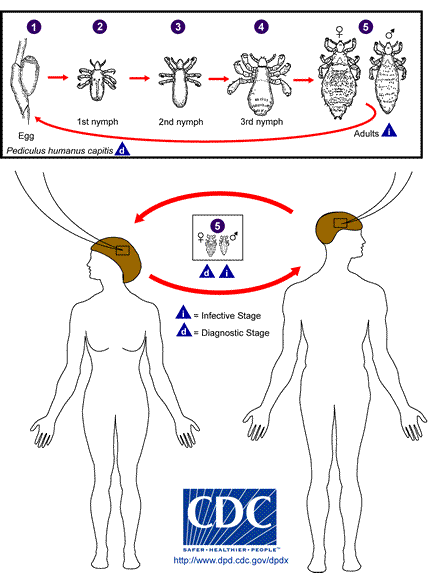
The life cycle of the head
louse has three stages: egg, nymph, and adult.
Eggs: Nits are head lice eggs. They are hard to see and are often
confused for dandruff or hair spray droplets. Nits are laid by the adult female and
are cemented at the base of the hair shaft nearest the scalp
 . They are 0.8 mm by 0.3
mm, oval and usually yellow to white. Nits take about 1 week to hatch (range 6 to 9
days). Viable eggs are usually located within 6 mm of the scalp.
. They are 0.8 mm by 0.3
mm, oval and usually yellow to white. Nits take about 1 week to hatch (range 6 to 9
days). Viable eggs are usually located within 6 mm of the scalp.
Nymphs: The egg hatches to release a nymph
 . The nit shell then
becomes a more visible dull yellow and remains attached to
the hair shaft. The nymph looks like an adult head louse, but is about the size of a
pinhead. Nymphs mature after three molts (
. The nit shell then
becomes a more visible dull yellow and remains attached to
the hair shaft. The nymph looks like an adult head louse, but is about the size of a
pinhead. Nymphs mature after three molts ( ,
,
 )
and become adults about 7 days after hatching.
)
and become adults about 7 days after hatching.
Adults: The adult louse is about the size of a sesame seed, has 6 legs
(each with claws), and is tan to grayish-white
 . In persons with dark hair, the adult
louse will appear darker. Females are usually larger than males and
can lay up to 8 nits per day. Adult lice can live up to 30 days on a person’s head. To
live, adult lice need to feed on blood several times daily. Without blood meals, the
louse will die within 1 to 2 days off the host.
. In persons with dark hair, the adult
louse will appear darker. Females are usually larger than males and
can lay up to 8 nits per day. Adult lice can live up to 30 days on a person’s head. To
live, adult lice need to feed on blood several times daily. Without blood meals, the
louse will die within 1 to 2 days off the host.
Geographic
Distribution:
Head lice infestation
is very common and is distributed worldwide. Preschool and elementary-age children, 3 to 10 years of age are infested most
often. Females are infested more often than males, probably due to more frequent
head-to-head contact. In the United States, African-Americans are rarely infested
with head lice. This is believed to be due to the American louse’s preference
for the shape and width of the hair shaft of other races.
|
||||||||
|
||||||||
|
||||||||
|
||||||||
|


