
 |
[Last Modified: ] |
 |
|
| [Isospora belli] |
 |
 |
 |
 |
 |
 |
|
Causal Agent:
The coccidian parasite,
Isospora belli, infects the epithelial cells of the small
intestine, and is the least common of the three intestinal coccidia that infect
humans.
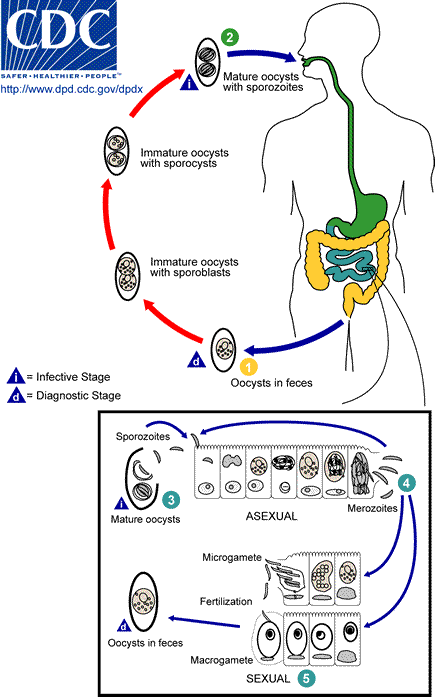
At time of excretion, the immature oocyst contains usually one sporoblast (more rarely two)
 . In further maturation after excretion, the sporoblast divides in two (the oocyst now contains two sporoblasts); the sporoblasts secrete a cyst wall, thus becoming sporocysts; and the sporocysts divide twice to produce four sporozoites each
 .
Infection occurs by ingestion of sporocysts-containing oocysts: the sporocysts excyst in the small intestine and release their sporozoites, which invade the epithelial cells and initiate schizogony
.
Infection occurs by ingestion of sporocysts-containing oocysts: the sporocysts excyst in the small intestine and release their sporozoites, which invade the epithelial cells and initiate schizogony
 . Upon rupture of the schizonts, the merozoites are released, invade new epithelial cells, and continue the cycle of asexual multiplication
 .
Trophozoites develop into schizonts which contain multiple merozoites. After a minimum of one week, the sexual stage begins with the development of male and female gametocytes
.
Trophozoites develop into schizonts which contain multiple merozoites. After a minimum of one week, the sexual stage begins with the development of male and female gametocytes
 . Fertilization results in the development of oocysts that are excreted in the stool
.
Isospora belli infects both humans and animals.
. Fertilization results in the development of oocysts that are excreted in the stool
.
Isospora belli infects both humans and animals.
Geographic
Distribution:
Worldwide, especially
in tropical and subtropical areas. Infection occurs in immunodepressed individuals,
and outbreaks have been reported in institutionalized groups in the United States.
|
||||||||
|
||||||||
|
||||||||
|
||||||||
|


