
 |
[Last Modified: ] |
 |
|
| [Leishmania spp.] |
 |
 |
 |
 |
 |
 |
|
Causal Agent:
Leishmaniasis is a vector-borne disease
that is transmitted by sandflies and caused by obligate intracellular
protozoa of the genus Leishmania. Human infection is caused by about 21 of 30 species that infect mammals. These include
the L. donovani complex with 3 species (L. donovani, L.
infantum, and L. chagasi); the L. mexicana complex with 3 main species
(L. mexicana, L. amazonensis, and L. venezuelensis); L. tropica; L.
major; L. aethiopica; and the subgenus Viannia with 4 main species
(L. (V.) braziliensis, L. (V.) guyanensis, L. (V.) panamensis, and L. (V.) peruviana). The different species are
morphologically indistinguishable, but they can be differentiated by isoenzyme analysis, molecular methods, or monoclonal antibodies.
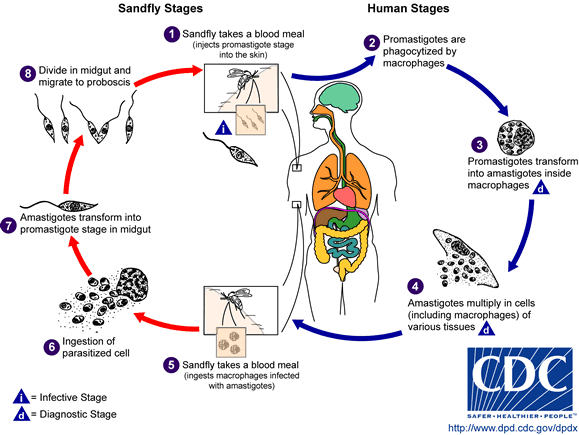
Leishmaniasis is
transmitted by the bite of female phlebotomine sandflies. The
sandflies inject the infective stage, promastigotes, during blood meals
 .
Promastigotes that reach the puncture wound are phagocytized by macrophages
.
Promastigotes that reach the puncture wound are phagocytized by macrophages
 and transform into amastigotes
 .
Amastigotes multiply in infected cells and affect different tissues,
depending in part on the Leishmania species
.
Amastigotes multiply in infected cells and affect different tissues,
depending in part on the Leishmania species
 .
This originates the clinical manifestations of leishmaniasis.
Sandflies become infected during blood meals on an infected host when they
ingest macrophages infected with amastigotes (
.
This originates the clinical manifestations of leishmaniasis.
Sandflies become infected during blood meals on an infected host when they
ingest macrophages infected with amastigotes ( ,
,
 ).
In the sandfly's midgut, the parasites differentiate into promastigotes
).
In the sandfly's midgut, the parasites differentiate into promastigotes
 ,
which multiply and migrate to the proboscis
,
which multiply and migrate to the proboscis
 .
.
Geographic
Distribution:
Leishmaniasis is found in parts of about 88 countries.
Approximately 350 million people live in these areas. Most of the affected countries are in the tropics and subtropics.
The settings in which leishmaniasis is found range from rain forests in Central and South America to deserts in West Asia.
More than 90 percent of the world's cases of visceral leishmaniasis are in India, Bangladesh, Nepal, Sudan, and Brazil.
Leishmaniasis is found in Mexico, Central America, and South America—from northern Argentina to southern Texas (not in Uruguay, Chile, or Canada), southern Europe (leishmaniasis is not common in travelers to southern Europe), Asia (not Southeast Asia), the Middle East, and Africa (particularly East and North Africa, with some cases elsewhere).
|
||||||||
|
||||||||
|
||||||||
|
||||||||
|


