
 |
[Last Modified: ] |
 |
|
| [Opisthorchis felineus] [Opisthorchis viverrini] |
 |
 |
 |
 |
 |
 |
|
Causal Agent:
Trematodes (flukes) Opisthorchis
viverrini (Southeast Asian liver fluke) and O. felineus (cat liver fluke).
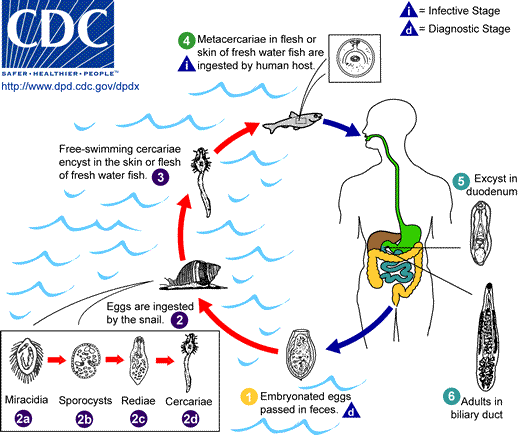
The adult flukes
deposit fully developed eggs that are passed in the feces
 . After ingestion by a suitable snail (first intermediate
host)
. After ingestion by a suitable snail (first intermediate
host)
 , the eggs
release miracidia
, the eggs
release miracidia
 , which undergo in the snail several developmental stages
(sporocysts
, which undergo in the snail several developmental stages
(sporocysts
 ,
rediae
,
rediae
 ,
cercariae
,
cercariae
 ). Cercariae are released from the snail
 and penetrate freshwater
fish (second intermediate host), encysting as metacercariae in the muscles or under the
scales
and penetrate freshwater
fish (second intermediate host), encysting as metacercariae in the muscles or under the
scales
 . The mammalian definitive host (cats, dogs, and various fish-eating mammals
including humans) become infected by ingesting undercooked fish containing metacercariae. After ingestion, the metacercariae excyst in the duodenum
. The mammalian definitive host (cats, dogs, and various fish-eating mammals
including humans) become infected by ingesting undercooked fish containing metacercariae. After ingestion, the metacercariae excyst in the duodenum
 and ascend through the
ampulla of Vater into the biliary ducts, where they attach and develop into adults, which
lay eggs after 3 to 4 weeks
and ascend through the
ampulla of Vater into the biliary ducts, where they attach and develop into adults, which
lay eggs after 3 to 4 weeks
 . The adult flukes (O.
viverrini: 5 mm to 10 mm by 1 mm to 2 mm; O. felineus: 7 mm to 12 mm by 2
mm to 3 mm) reside in the biliary and pancreatic ducts of the mammalian host, where
they attach to the mucosa.
. The adult flukes (O.
viverrini: 5 mm to 10 mm by 1 mm to 2 mm; O. felineus: 7 mm to 12 mm by 2
mm to 3 mm) reside in the biliary and pancreatic ducts of the mammalian host, where
they attach to the mucosa.
Geographic
Distribution:
O. viverrini is
found mainly in northeast Thailand, Laos, and Kampuchea. O. felineus is found
mainly in Europe and Asia, including the former Soviet Union.
|
||||||||
|
||||||||
|
||||||||
|
||||||||
|


