
 |
[Last Modified: ] |
 |
|
| [Sarcoptes scabei] |
 |
 |
 |
 |
 |
 |
|
Causal Agent:
Sarcoptes scabei, human
itch or mange mites, are in the arthropod class Arachnida, subclass Acari, family
Sarcoptidae. The mites burrow into the skin but never below the
stratum corneum. The burrows appear as raised serpentine lines up to
several centimeters long.
Other races of scabies may cause infestations in other mammals such as domestic cats,
dogs, pigs, and horses. It should be noted that races of mites found on other animals
may establish infestations in humans. They may cause temporary itching due
to dermatitis but they do not multiply on the human host.
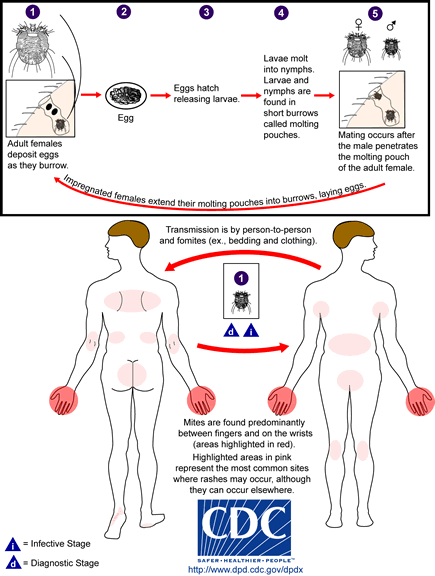
Sarcoptes
scabei undergoes four stages in its life cycle; egg, larva, nymph and
adult. Females deposit eggs at 2 to 3 day intervals as
they burrow through the skin
 . Eggs are oval and 0.1 to 0.15 mm in
length
. Eggs are oval and 0.1 to 0.15 mm in
length
 and incubation time is 3 to 8 days. After the eggs hatch, the
larvae migrate to the skin surface and burrow into the intact stratum
corneum to construct almost invisible, short burrows called molting
pouches. The larval stage, which
emerges from the eggs, has only 3 pairs of legs
and incubation time is 3 to 8 days. After the eggs hatch, the
larvae migrate to the skin surface and burrow into the intact stratum
corneum to construct almost invisible, short burrows called molting
pouches. The larval stage, which
emerges from the eggs, has only 3 pairs of legs
 ,
and this form lasts 2 to 3 days. After larvae molt, the resulting nymphs
have 4 pairs of legs
,
and this form lasts 2 to 3 days. After larvae molt, the resulting nymphs
have 4 pairs of legs
 .
This form molts into slightly larger nymphs before molting into adults.
Larvae and nymphs may often be found in molting
pouches or in hair follicles and look similar to adults, only smaller. Adults are round, sac-like
eyeless mites. Females are 0.3 to 0.4 mm long and 0.25 to 0.35 mm
wide, and males are slightly more than half that size. Mating occurs
after the nomadic male penetrates the molting pouch of the adult female
.
This form molts into slightly larger nymphs before molting into adults.
Larvae and nymphs may often be found in molting
pouches or in hair follicles and look similar to adults, only smaller. Adults are round, sac-like
eyeless mites. Females are 0.3 to 0.4 mm long and 0.25 to 0.35 mm
wide, and males are slightly more than half that size. Mating occurs
after the nomadic male penetrates the molting pouch of the adult female
 .
Impregnated females extend their molting pouches into the characteristic
serpentine burrows, laying eggs in the process. The impregnated females burrow into the skin and
spend the remaining 2 months of their lives in tunnels under the surface of the
skin.
Males are rarely seen. They make a temporary gallery in the skin
before mating.
.
Impregnated females extend their molting pouches into the characteristic
serpentine burrows, laying eggs in the process. The impregnated females burrow into the skin and
spend the remaining 2 months of their lives in tunnels under the surface of the
skin.
Males are rarely seen. They make a temporary gallery in the skin
before mating.
Transmission occurs by the transfer of ovigerous females during personal
contact. Mode of transmission is primarily person-to-person contact,
but transmission may also occur via fomites (e.g., bedding or clothing).
Mites are found predominantly between the fingers and on the wrists.
The mites hold onto the skin using suckers attached to the two most
anterior pairs of legs.
Geographic
Distribution:
Scabies mites are
distributed worldwide, affecting all races and socioeconomic classes in all climates.
|
||||||||
|
||||||||
|
||||||||
|
||||||||
|


