
 |
[Last Modified: ] |
 |
|
| [Trypanosoma
brucei gambiense] [Trypanosoma brucei rhodesiense] |
|
 |
 |
 |
 |
 |
 |
|
Causal Agents:
Protozoan
hemoflagellates belonging to the complex Trypanosoma brucei. Two subspecies
that are morphologically indistinguishable cause distinct disease patterns in humans: T.
b. gambiense causes West African sleeping sickness and T. b. rhodesiense causes
East African sleeping sickness. (A third member of the complex, T. b. brucei,
under normal conditions does not infect humans.)
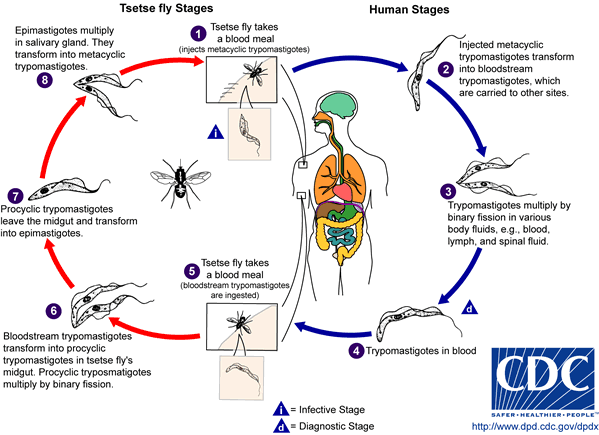
During a
blood meal on the mammalian host, an infected tsetse fly (genus Glossina)
injects metacyclic trypomastigotes into skin tissue. The parasites
enter the lymphatic system and pass into the bloodstream
 . Inside the
host, they transform into bloodstream trypomastigotes
. Inside the
host, they transform into bloodstream trypomastigotes
 , are carried to other
sites throughout the body, reach other blood fluids (e.g., lymph, spinal
fluid), and continue the replication by binary fission
, are carried to other
sites throughout the body, reach other blood fluids (e.g., lymph, spinal
fluid), and continue the replication by binary fission
 . The entire
life cycle of African Trypanosomes is represented by extracellular stages.
The tsetse fly becomes infected with bloodstream trypomastigotes when taking
a blood meal on an infected mammalian host (
. The entire
life cycle of African Trypanosomes is represented by extracellular stages.
The tsetse fly becomes infected with bloodstream trypomastigotes when taking
a blood meal on an infected mammalian host ( ,
,
 ). In the fly’s midgut, the
parasites transform into procyclic trypomastigotes, multiply by binary
fission
). In the fly’s midgut, the
parasites transform into procyclic trypomastigotes, multiply by binary
fission
 , leave the midgut, and transform into epimastigotes
 . The
epimastigotes reach the fly’s salivary glands and continue multiplication by
binary fission
. The
epimastigotes reach the fly’s salivary glands and continue multiplication by
binary fission
 . The cycle in the fly takes approximately 3 weeks.
Humans are the main reservoir for Trypanosoma brucei gambiense, but
this species can also be found in animals. Wild game animals are the
main reservoir of T. b. rhodesiense.
. The cycle in the fly takes approximately 3 weeks.
Humans are the main reservoir for Trypanosoma brucei gambiense, but
this species can also be found in animals. Wild game animals are the
main reservoir of T. b. rhodesiense.
Geographic
Distribution:
T. b. gambiense
is found in foci in large areas of West and Central Africa. The distribution of T.
b. rhodesiense is much more limited, with the species found in East and Southeast
Africa.
|
||||||||
|
||||||||
|
||||||||
|
||||||||
|


