|
 |
[Last Modified: ] |
 |
|
| [Blastocystis
hominis] |
|
|
|
Blastocystis
hominis stages were reproduced from Singh M, Suresh K, Ho LC, Ng GC, Yap
EH. Elucidation of
the life cycle of the intestinal protozoan Blastocystis hominis. Parasitol Res
1995;81:449. Copyright held by Springer-Verlag and reproduced here by
permission of Springer-Verlag and M. Singh.
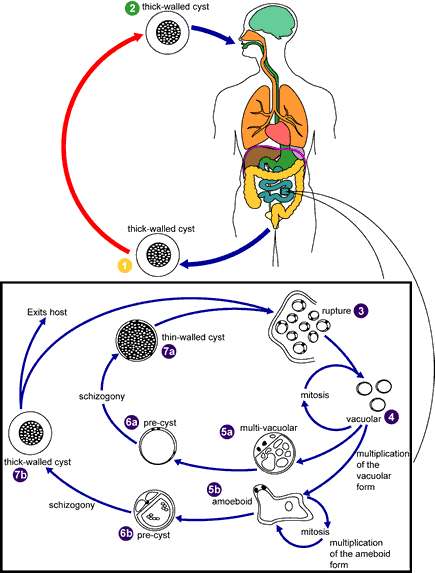
Knowledge of the life cycle and transmission is still under
investigation, therefore this is a proposed life cycle for B. hominis. The
classic form found in human stools is the cyst, which varies tremendously in
size from 6 to 40 μm
 . The thick-walled cyst present in the stools
is believed to be responsible for external transmission, possibly by the fecal-oral route through ingestion of contaminated water or food . The thick-walled cyst present in the stools
is believed to be responsible for external transmission, possibly by the fecal-oral route through ingestion of contaminated water or food
 . The cysts
infect epithelial cells of the digestive tract and multiply asexually
( . The cysts
infect epithelial cells of the digestive tract and multiply asexually
( , ,
 ). Vacuolar forms of the parasite give origin to multi-vacuolar ). Vacuolar forms of the parasite give origin to multi-vacuolar
 and ameboid and ameboid
 forms. The multi-vacuolar develops into a pre-cyst forms. The multi-vacuolar develops into a pre-cyst
 that
gives origin to a thin-walled cyst that
gives origin to a thin-walled cyst
 , thought to be responsible for
autoinfection. The ameboid form gives origin to a pre-cyst , thought to be responsible for
autoinfection. The ameboid form gives origin to a pre-cyst
 , which
develops into thick-walled cyst by schizogony , which
develops into thick-walled cyst by schizogony
 . .
|
|