|
 |
[Last
Modified: ] |
 |
|
| [Cyclospora
cayetanensis] |
|
|
|
Some of
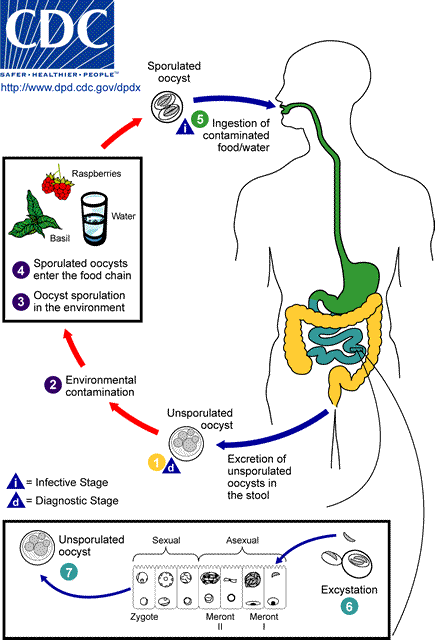
elements of this figure were created based on an illustration by Ortega
et al. Cyclospora cayetanensis. In: Advances in Parasitology: opportunistic
protozoa in humans. San Diego: Academic Press; 1998. p. 399-418.
When
freshly passed in stools, the oocyst is not infective
 (thus, direct fecal-oral transmission cannot occur; this differentiates
Cyclospora from another important coccidian parasite, Cryptosporidium).
In the environment
(thus, direct fecal-oral transmission cannot occur; this differentiates
Cyclospora from another important coccidian parasite, Cryptosporidium).
In the environment
 ,
sporulation occurs after days or weeks at temperatures between 22°C to
32°C, resulting in division of the sporont into two sporocysts, each
containing two elongate sporozoites ,
sporulation occurs after days or weeks at temperatures between 22°C to
32°C, resulting in division of the sporont into two sporocysts, each
containing two elongate sporozoites
 .
Fresh produce and water can serve as vehicles for transmission .
Fresh produce and water can serve as vehicles for transmission
 and the sporulated oocysts are ingested (in contaminated food or water)
 .
The oocysts excyst in the gastrointestinal tract, freeing the sporozoites
which invade the epithelial cells of the small intestine .
The oocysts excyst in the gastrointestinal tract, freeing the sporozoites
which invade the epithelial cells of the small intestine
 .
Inside the cells they undergo asexual multiplication and sexual development
to mature into oocysts, which will be shed in stools .
Inside the cells they undergo asexual multiplication and sexual development
to mature into oocysts, which will be shed in stools
 .
The potential mechanisms of contamination of food and water are still
under investigation. .
The potential mechanisms of contamination of food and water are still
under investigation.
|
|