|
 |
[Last Modified: ] |
 |
|
| [Taenia
solium] [Taenia spp.] |
|
|
|
 |
Cysticercosis
is an infection of both humans and pigs with the larval stages of the
parasitic cestode, Taenia solium. This infection is caused by
ingestion of eggs shed in the feces of a human tapeworm carrier
 .
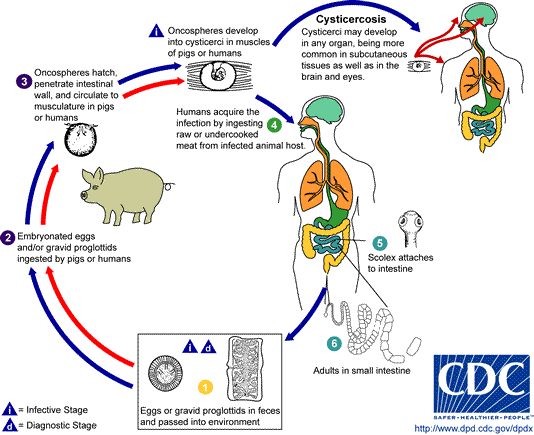
Pigs and humans become
infected by ingesting eggs or gravid proglottids .
Pigs and humans become
infected by ingesting eggs or gravid proglottids
 .
Humans are infected either by ingestion of food contaminated with feces,
or by autoinfection. In the latter case, a human infected with adult
T. solium can ingest eggs produced by that tapeworm, either through fecal
contamination or, possibly, from proglottids carried into the stomach by
reverse peristalsis. Once eggs are ingested, oncospheres hatch in
the intestine .
Humans are infected either by ingestion of food contaminated with feces,
or by autoinfection. In the latter case, a human infected with adult
T. solium can ingest eggs produced by that tapeworm, either through fecal
contamination or, possibly, from proglottids carried into the stomach by
reverse peristalsis. Once eggs are ingested, oncospheres hatch in
the intestine
 ,
invade the
intestinal wall, and migrate to striated muscles, as well as the brain,
liver, and other tissues, where they develop into cysticerci. In humans, cysts can cause serious sequellae if they
localize in the brain, resulting in neurocysticercosis. The parasite
life cycle is completed, resulting in human tapeworm infection, when
humans ingest undercooked pork containing cysticerci ,
invade the
intestinal wall, and migrate to striated muscles, as well as the brain,
liver, and other tissues, where they develop into cysticerci. In humans, cysts can cause serious sequellae if they
localize in the brain, resulting in neurocysticercosis. The parasite
life cycle is completed, resulting in human tapeworm infection, when
humans ingest undercooked pork containing cysticerci
 .
Cysts evaginate and attach to the small intestine by their scolex .
Cysts evaginate and attach to the small intestine by their scolex
 .
Adult tapeworms develop, (up to 2 to 7 m in length and produce less than
1000 proglottids, each with approximately 50,000 eggs) and reside in the
small intestine for years .
Adult tapeworms develop, (up to 2 to 7 m in length and produce less than
1000 proglottids, each with approximately 50,000 eggs) and reside in the
small intestine for years
 . .
|
|


