
 |
[Last Modified: ] |
 |
|
| [Echinococcus
granulosus] [Echinococcus multilocularis] [Echinococcus oligarthrus] [Echinococcus vogeli] |
|
Life Cycle:
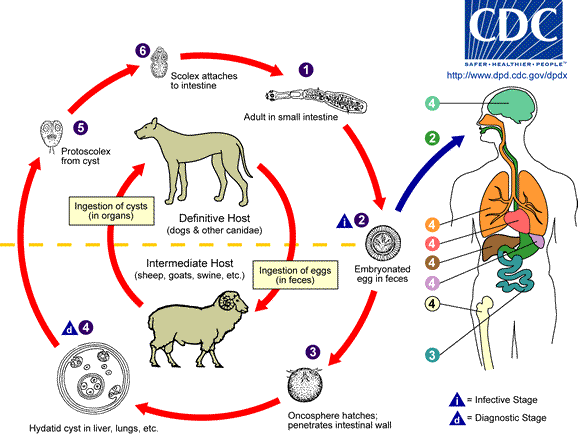 |
The adult Echinococcus
granulosus (3 to 6 mm long)
 resides in the small bowel of the definitive hosts, dogs or other canids.
Gravid proglottids release eggs
resides in the small bowel of the definitive hosts, dogs or other canids.
Gravid proglottids release eggs
 that are passed in the feces. After ingestion by a suitable intermediate
host (under natural conditions: sheep, goat, swine, cattle, horses, camel),
the egg hatches in the small bowel and releases an oncosphere
that are passed in the feces. After ingestion by a suitable intermediate
host (under natural conditions: sheep, goat, swine, cattle, horses, camel),
the egg hatches in the small bowel and releases an oncosphere
 that penetrates the intestinal wall and migrates through the circulatory
system into various organs, especially the liver and lungs. In these
organs, the oncosphere develops into a cyst
that penetrates the intestinal wall and migrates through the circulatory
system into various organs, especially the liver and lungs. In these
organs, the oncosphere develops into a cyst
 that enlarges gradually, producing protoscolices and daughter cysts that
fill the cyst interior. The definitive host becomes infected by ingesting
the cyst-containing organs of the infected intermediate host. After
ingestion, the protoscolices
that enlarges gradually, producing protoscolices and daughter cysts that
fill the cyst interior. The definitive host becomes infected by ingesting
the cyst-containing organs of the infected intermediate host. After
ingestion, the protoscolices
 evaginate, attach to the intestinal mucosa
 ,
and develop into adult stages
in 32 to 80 days. The same life cycle occurs with E. multilocularis
(1.2 to 3.7 mm), with the following differences: the definitive hosts are
foxes, and to a lesser extent dogs, cats, coyotes and wolves; the intermediate
host are small rodents; and larval growth (in the liver) remains indefinitely
in the proliferative stage, resulting in invasion of the surrounding tissues.
With E. vogeli (up to 5.6 mm long), the definitive hosts are bush
dogs and dogs; the intermediate hosts are rodents; and the larval stage
(in the liver, lungs and other organs) develops both externally and internally,
resulting in multiple vesicles. E. oligarthrus (up to 2.9 mm
long) has a life cycle that involves wild felids as definitive hosts and
rodents as intermediate hosts. Humans become infected by ingesting
eggs
,
and develop into adult stages
in 32 to 80 days. The same life cycle occurs with E. multilocularis
(1.2 to 3.7 mm), with the following differences: the definitive hosts are
foxes, and to a lesser extent dogs, cats, coyotes and wolves; the intermediate
host are small rodents; and larval growth (in the liver) remains indefinitely
in the proliferative stage, resulting in invasion of the surrounding tissues.
With E. vogeli (up to 5.6 mm long), the definitive hosts are bush
dogs and dogs; the intermediate hosts are rodents; and the larval stage
(in the liver, lungs and other organs) develops both externally and internally,
resulting in multiple vesicles. E. oligarthrus (up to 2.9 mm
long) has a life cycle that involves wild felids as definitive hosts and
rodents as intermediate hosts. Humans become infected by ingesting
eggs
 ,
with resulting release of oncospheres
,
with resulting release of oncospheres
 in the intestine and the development of cysts
 ,
,
 ,
,
 ,
,
 ,
,
 ,
,
 in various organs.
|
||||||||
|
||||||||
|
||||||||
|
||||||||
|


