|
 |
[Last Modified: ] |
 |
|
| [Gnathostoma
spinigerum, Gnathostoma hispidum] |
|
|
|
Adapted from a drawing
provided by
Dr. Sylvia Paz Díaz Camacho, Universidade Autónoma de Sinaloa, Mexico.
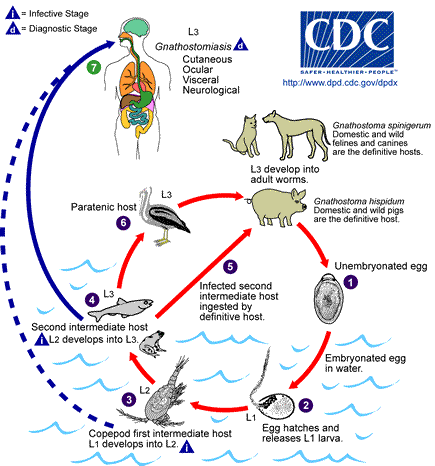
In the natural definitive host
(pigs, cats, dogs, wild animals) the adult worms reside in a tumor which they induce in the
gastric wall. They deposit eggs that are unembryonated when passed in the
feces
 .
Eggs become embryonated in water, and eggs release first-stage larvae .
Eggs become embryonated in water, and eggs release first-stage larvae
 . If
ingested by a small crustacean (Cyclops, first intermediate host), the
first-stage larvae develop into second-stage larvae . If
ingested by a small crustacean (Cyclops, first intermediate host), the
first-stage larvae develop into second-stage larvae
 . Following ingestion of the Cyclops by a fish, frog, or
snake (second intermediate host), the second-stage larvae migrate into the flesh and
develop into third-stage larvae . Following ingestion of the Cyclops by a fish, frog, or
snake (second intermediate host), the second-stage larvae migrate into the flesh and
develop into third-stage larvae
 . When the
second intermediate host is ingested by a definitive host, the third-stage
larvae develop into adult
parasites in the stomach wall . When the
second intermediate host is ingested by a definitive host, the third-stage
larvae develop into adult
parasites in the stomach wall
 . Alternatively, the second intermediate host may
be ingested by the paratenic host (animals such as birds, snakes, and frogs)
in which the third-stage larvae do not develop further
but remain infective to the next predator . Alternatively, the second intermediate host may
be ingested by the paratenic host (animals such as birds, snakes, and frogs)
in which the third-stage larvae do not develop further
but remain infective to the next predator
 . Humans become infected by eating
undercooked fish or poultry containing third-stage larvae, or reportedly by drinking water containing
infective second-stage larvae in Cyclops . Humans become infected by eating
undercooked fish or poultry containing third-stage larvae, or reportedly by drinking water containing
infective second-stage larvae in Cyclops
 . .
|
|