
 |
[Last Modified: ] |
 |
|
| [Pneumocystis jiroveci] | |
 |
Pneumocystis stages were reproduced
from a drawing by Dr. John J. Ruffolo, South
Dakota State University, USA published in Cushion M. Pneumocystis
carinii. In: Collier L, Balows A, Sussman M, editors. Topley and
Wilson's Microbiology and Microbial Infections: Volume 4 Medical Mycology,
9th ed. New York: Arnold Publishing; 1998. p. 674. Copyright held by Arnold Publishing
and reproduced here by permission of Arnold and
Dr. Ruffolo.
Our thanks to Dr. Melanie T. Cushion for her comments
on the life cycle text.
References:
- Ruffolo JJ. Pneumocystis carinii Cell Structure. In: Walzer, PD, editor. Pneumocystis carinii Pneumonia. 2nd ed. Marcel Dekker; 1994. p. 25-43.
- Cushion MT, Ruffolo JJ, Walzer PD. Analysis of the developmental stages of Pneumocystis carinii in vitro. Lab Invest 1988;58:324-331.
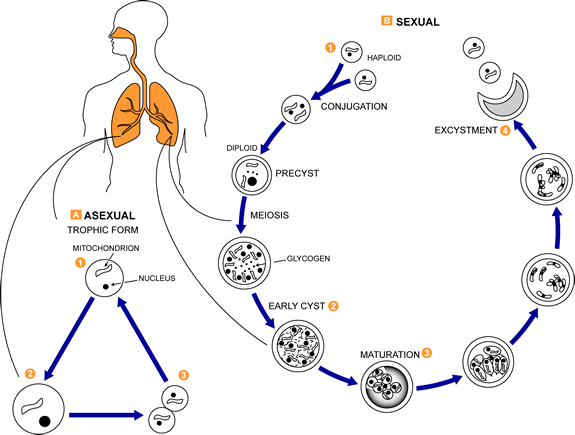
This is a
generalized life
cycle proposed by John J. Ruffolo, Ph.D.
(Cushion, MT, 1988) for the various species of
Pneumocystis. These fungi are found in the lungs of mammals where
they reside without causing overt infection until the host's immune system
becomes debilitated. Then, an oftentimes lethal pneumonia can result. Asexual phase: trophic forms
 replicate by mitosis
 to
to
 .
Sexual phase: haploid trophic forms conjugate
and produce a zygote or sporocyte (early cyst)
.
The zygote undergoes meiosis and subsequent mitosis to produce eight
haploid nuclei (late phase cyst)
.
Spores exhibit different shapes (such as, spherical and elongated forms).
It is postulated that elongation of the spores precedes release from the
spore case. It is believed that the release occurs through a rent in
the cell wall. After release, the empty spore case usually collapses,
but retains some residual cytoplasm
.
Sexual phase: haploid trophic forms conjugate
and produce a zygote or sporocyte (early cyst)
.
The zygote undergoes meiosis and subsequent mitosis to produce eight
haploid nuclei (late phase cyst)
.
Spores exhibit different shapes (such as, spherical and elongated forms).
It is postulated that elongation of the spores precedes release from the
spore case. It is believed that the release occurs through a rent in
the cell wall. After release, the empty spore case usually collapses,
but retains some residual cytoplasm
 .
A trophic stage, where the organisms probably multiply by binary fission
is also recognized to exist. The organism causes disease
in immunosuppressed individuals.
.
A trophic stage, where the organisms probably multiply by binary fission
is also recognized to exist. The organism causes disease
in immunosuppressed individuals.
|
||||||||
|
||||||||
|
||||||||
|
||||||||
|


