|
 |
[Last Modified: ] |
 |
|
| [Taenia
saginata] [T. solium] |
|
|
|
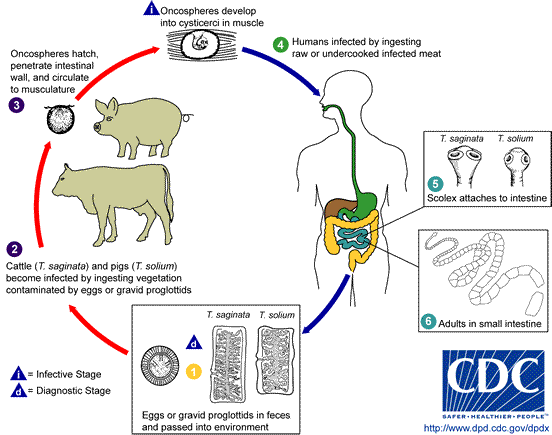 |
Life cycle of Taenia
saginata and Taenia solium
Humans are the only definitive hosts for Taenia saginata and Taenia
solium.
Eggs or gravid proglottids are passed with feces
 ;
the eggs can
survive for days to months in the environment. Cattle (T. saginata)
and pigs (T. solium) become
infected by ingesting vegetation contaminated with eggs or gravid
proglottids ;
the eggs can
survive for days to months in the environment. Cattle (T. saginata)
and pigs (T. solium) become
infected by ingesting vegetation contaminated with eggs or gravid
proglottids
 . In the
animal's intestine, the oncospheres hatch . In the
animal's intestine, the oncospheres hatch
 ,
invade the
intestinal wall, and migrate to the striated muscles, where they develop into
cysticerci. A cysticercus can survive for several years in the animal.
Humans
become infected by ingesting raw or undercooked infected meat ,
invade the
intestinal wall, and migrate to the striated muscles, where they develop into
cysticerci. A cysticercus can survive for several years in the animal.
Humans
become infected by ingesting raw or undercooked infected meat
 . In the human
intestine, the cysticercus develops over 2 months into an adult tapeworm, which can
survive for years. The
adult tapeworms attach to the
small intestine by their scolex . In the human
intestine, the cysticercus develops over 2 months into an adult tapeworm, which can
survive for years. The
adult tapeworms attach to the
small intestine by their scolex
 and reside in the small intestine
 .
Length of adult worms is usually 5 m or less for T. saginata (however
it may reach up to 25 m) and 2 to 7 m for T. solium. The adults produce proglottids which mature, become gravid, detach from the tapeworm, and
migrate to the anus or are passed in the stool (approximately 6 per day).
T. saginata adults usually have 1,000 to 2,000 proglottids, while T.
solium adults have an average of 1,000 proglottids. The eggs
contained in the gravid proglottids are released
after the proglottids are passed with the feces. T. saginata
may produce up to 100,000 and T. solium may produce 50,000 eggs per
proglottid respectively. .
Length of adult worms is usually 5 m or less for T. saginata (however
it may reach up to 25 m) and 2 to 7 m for T. solium. The adults produce proglottids which mature, become gravid, detach from the tapeworm, and
migrate to the anus or are passed in the stool (approximately 6 per day).
T. saginata adults usually have 1,000 to 2,000 proglottids, while T.
solium adults have an average of 1,000 proglottids. The eggs
contained in the gravid proglottids are released
after the proglottids are passed with the feces. T. saginata
may produce up to 100,000 and T. solium may produce 50,000 eggs per
proglottid respectively.
|
|


