|
 |
[Last Modified: ] |
 |
|
| [Trypanosoma
brucei gambiense] [T. b. rhodesiense] |
|
|
|
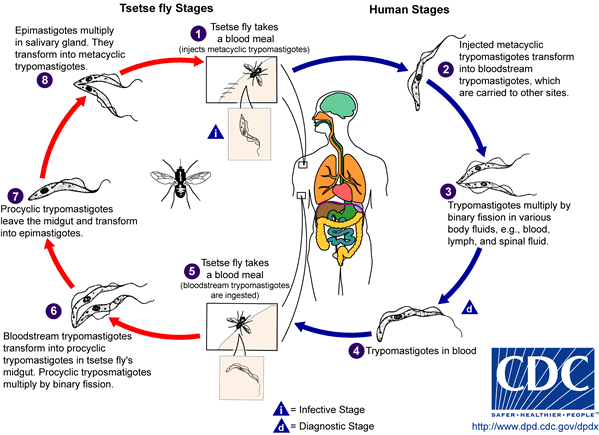 |
During a
blood meal on the mammalian host, an infected tsetse fly (genus Glossina)
injects metacyclic trypomastigotes into skin tissue. The parasites
enter the lymphatic system and pass into the bloodstream
 . Inside the
host, they transform into bloodstream trypomastigotes . Inside the
host, they transform into bloodstream trypomastigotes
 , are carried to other
sites throughout the body, reach other blood fluids (e.g., lymph, spinal
fluid), and continue the replication by binary fission , are carried to other
sites throughout the body, reach other blood fluids (e.g., lymph, spinal
fluid), and continue the replication by binary fission
 . The entire
life cycle of African Trypanosomes is represented by extracellular stages.
The tsetse fly becomes infected with bloodstream trypomastigotes when taking
a blood meal on an infected mammalian host ( . The entire
life cycle of African Trypanosomes is represented by extracellular stages.
The tsetse fly becomes infected with bloodstream trypomastigotes when taking
a blood meal on an infected mammalian host ( , ,
 ). In the fly’s midgut, the
parasites transform into procyclic trypomastigotes, multiply by binary
fission ). In the fly’s midgut, the
parasites transform into procyclic trypomastigotes, multiply by binary
fission
 , leave the midgut, and transform into epimastigotes , leave the midgut, and transform into epimastigotes
 . The
epimastigotes reach the fly’s salivary glands and continue multiplication by
binary fission . The
epimastigotes reach the fly’s salivary glands and continue multiplication by
binary fission
 . The cycle in the fly takes approximately 3 weeks.
Humans are the main reservoir for Trypanosoma brucei gambiense, but
this species can also be found in animals. Wild game animals are the
main reservoir of T. b. rhodesiense. . The cycle in the fly takes approximately 3 weeks.
Humans are the main reservoir for Trypanosoma brucei gambiense, but
this species can also be found in animals. Wild game animals are the
main reservoir of T. b. rhodesiense.
|
|


