A state public
health laboratory submitted a formalin preserved stool specimen to CDC's
reference laboratory for diagnosis. The specimen was from a middle-aged
woman with complaints of abdominal pain and diarrhea. The symptoms
began approximately a week after attending a social function. According
to the patient, she ate only dessert (with fruit punch) at the social function.
Since then, she has eaten only food prepared by herself. The specimen
was processed using the FEA stool concentration method and a wet-mount slide
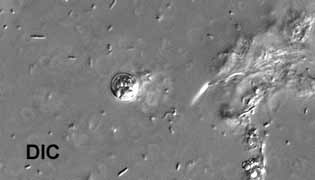
prepared from the sediment. Images taken from the slide (1
and 2) show a side-by-side composite of a representative object using
UV fluorescence and differential interference contrast (DIC) microscopy.
All objects were approximately 9 µm in diameter. From the choices
below, which parasite do you identify?
 |
 |
| 1 |
2 |
(a)
Giardia intestinalis
(b)
Cryptosporidium parvum
(c)
Cyclospora cayetanensis
(d)
Ascaris lumbricoides
|