
Answer to
Case 38
This was a case of trichinellosis caused by Trichinella spiralis (sensu
lato). The presence of small nematode larvae encapsulated in striated
muscle is characteristic of infection with this nematode. Examination
of a wet tissue compression smear will sometimes reveal coiled larvae.
However, if the number of larvae present is small, digestion of a larger
sample of meat using artificial gastric juice is necessary. Diagnostic
features observed were:
- Size (0.8 to 1.0 mm)
- Blunt tail
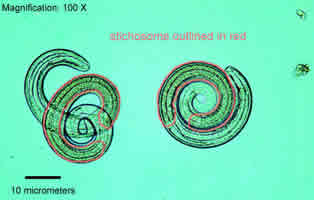
- Characteristic stichosome that is composed of the esophagus surrounded by individual stichocytes (Figure A).
 |
| A |
In the United States and other countries, control of trichinellosis has been achieved because of a combination of factors, including a decrease in the prevalence of infection in market hogs. However, wild animals continue to harbor infections and serve as a source of human infection when meat products are poorly cooked. In the United States, the most recent cases have been from ingestion of bear meat, although cougars have also been implicated. Salting, smoking, and drying of meat are not effective at killing the larvae of Trichinella sp. Some strains from the Nearctic are highly resistant to freezing, as part of the parasites’ adaption to survival.
Note: What was once considered a single species, Trichinella spiralis, is now thought to consist of at least five different species (T. spiralis, T. pseudospiralis, T. nativa, T. nelsoni, and T. britova) each with a slightly different geographical distribution and normal range of hosts. All are potentially infective to humans and T. pseudospiralis is the most distinct in that it does not, in the larval stage, typically induce a marked host capsule around the larvae.
Click here to learn more about trichinosis. CDC tracks trichinellosis cases. See recent reference:
Moorhead A, Grunenwald PE, Dietz V J, Schantz PM. Trichinellosis in the United States, 1991-1996: Declining but not gone. Am J Trop Med Hyg 1999;60:66-9.
|