|
Microscopy
 |
 |
| A |
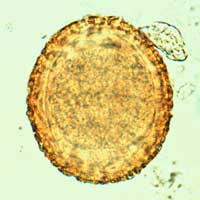
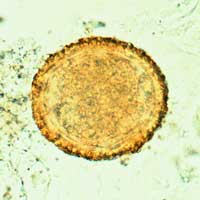
A: Unembryonated eggs of Baylisascaris procyonis. These eggs are thick-shelled
and usually a little oval in shape. Size of these eggs is 80-85 microns
by 65-70 microns. The eggs of B. procyonis are morphologically
similar to fertile eggs of Ascaris lumbricoides, but they differ in
size with eggs of A.
lumbricoides eggs measuring 55 to 75 microns by 35 to 50 microns. Unembryonated eggs of B.
procyonis are passed only in the feces of raccoons and skunks (and
sometimes other carnivorous animals) onto the soil. They further
develop to the infective second-stage larva in about 2 to 3 weeks.
Humans become infected by accidentally ingesting infective eggs from soil,
water, hands, food or other objects, which have been contaminated with
feces from B. procyonis-infected raccoon or skunk. Humans
infected with B. procyonis do not shed eggs in feces.
|
|





