
 |
[Last Modified: ] |
 |
|
| [Dracunculus medinensis] |
 |
 |
 |
 |
 |
 |
|
Causal Agent:
Dracunculiasis (guinea worm
disease) is caused by the nematode (roundworm) Dracunculus medinensis.
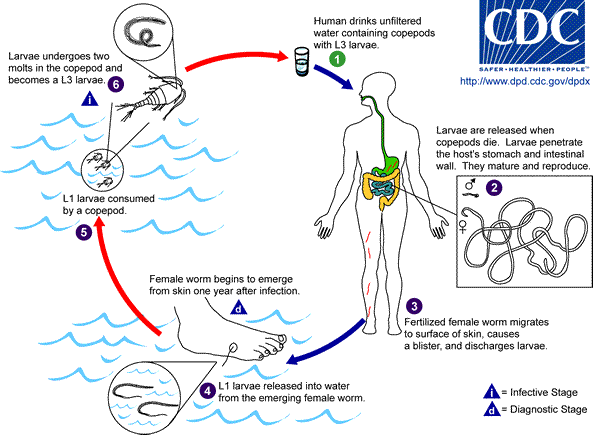
Humans become infected by
drinking unfiltered water containing copepods (small crustaceans) which are infected with
larvae of D. medinensis
 . Following ingestion, the copepods
die and release
the larvae, which penetrate the host stomach and intestinal wall and enter the abdominal
cavity and retroperitoneal space
. Following ingestion, the copepods
die and release
the larvae, which penetrate the host stomach and intestinal wall and enter the abdominal
cavity and retroperitoneal space
 . After maturation into adults and copulation, the male
worms die and the females (length: 70 to 120 cm) migrate in the subcutaneous tissues
towards the skin surface
. After maturation into adults and copulation, the male
worms die and the females (length: 70 to 120 cm) migrate in the subcutaneous tissues
towards the skin surface
 . Approximately one year after infection, the female worm induces
a blister on the skin, generally on the distal lower extremity, which ruptures.
When this
lesion comes into contact with water, a contact that the patient seeks to relieve the
local discomfort, the female worm emerges and releases larvae
. Approximately one year after infection, the female worm induces
a blister on the skin, generally on the distal lower extremity, which ruptures.
When this
lesion comes into contact with water, a contact that the patient seeks to relieve the
local discomfort, the female worm emerges and releases larvae
 .
The larvae
are ingested by a copepod
.
The larvae
are ingested by a copepod
 and after two weeks (and two molts) have developed into
infective larvae
and after two weeks (and two molts) have developed into
infective larvae
 . Ingestion of the copepods closes the
cycle
.
. Ingestion of the copepods closes the
cycle
.
Geographic
Distribution:
An ongoing eradication campaign
has dramatically reduced the incidence of dracunculiasis, which is now restricted to
rural, isolated areas in a narrow belt of African countries.
|
||||||||
|
||||||||
|
||||||||
|
||||||||
|


